Advanced Typography / Task 1: Exercise 1&2
Week 01-Week 04
Jennifer Huang / 0352990
Bachelor of Design in Creative Media
Advanced Typography

LECTURE NOTES
Lecture 1 :
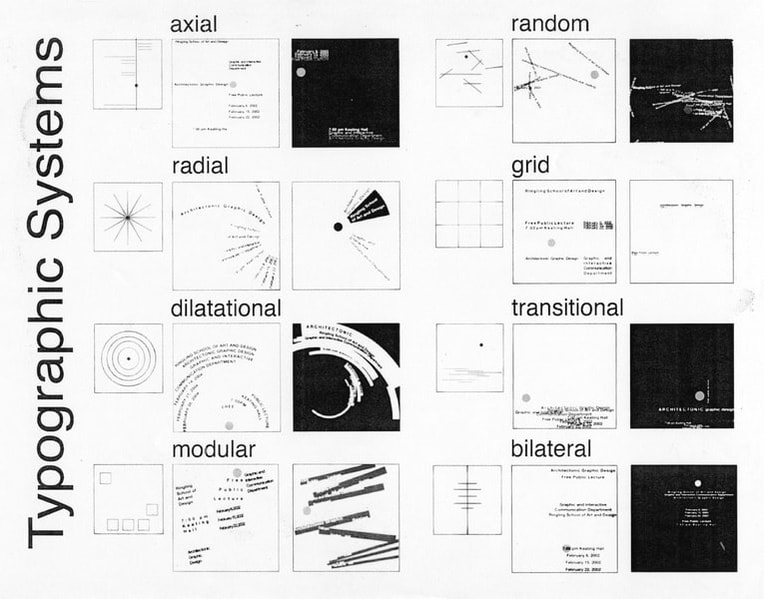
Typographic Systems, "All Designs is based on a structural system" and
according to Elam, 2007, there are eight major variations with an infinite
number of permutations. These eight major variations are :
- Axial
- Radial
- Dilatational
- Random
- Grid
- Modular
- Transitional
- Bilateral
"Typographical organization is complex because the elements are dependent
on communication in order to function. Additional criteria such as
hierarchy, order of reading, legibility, and contrast also come into play.
The typographic systems are skin to what architects term shape grammars. The
typographic systems are similar that the systems has a set of rules is
unique and provides a sense of purpose that focuses and directs the decision
making" While some may feel this imposition takes away intuition from a
teaching point of view it provides a solid framework that allows learners to
be guided in their exploration while their intuition develops and
matures.
Axial System : All elements are organized either to the left or right of single
axis.
Radial System : All elements extend from a point of focus.
Dilatational System : All elements expand from a central point in a circular
fashion
Random System : Elements appear to have no specific pattern or
relationship.
Grid System : A system of vertical and horizontal divisions. The text box
needs to be placed inside the grid.
Transitional System : An informal system of layered banding. Moving from one
direction.
Modular System : A series of non-objective elements that are
constructed in as a standardized units.
Bilateral System : All text is arranged symmetrically on a single
axis.

Figure.1 Typographic Systems from Google
INSTRUCTIONS
Advanced Typography Module Information Booklet.
Task 1 (20%) : Exercises
Typographic Systems (1 Week)
Axial, Radial, Dilatational, Random, Grid, Modular, Transitional and Bilateral. The exercise task is to be done using Adobe InDesign only. Size 200x200 mm. In addition to black, you can use one other color. Graphical elements (line, dot, etc.) can be used but limitedly.
Type & Play Part 1 & 2 (2 Week)
Finding type - Students will be asked to select an image of a man-made object (chair, glass, etc.) or structures (buildings), or something from nature (Human, landscape, leaf, plant, bush, clouds, hill, river, etc.). Ensure that the image does not contain many different elements.
Students will analyse, dissect and identify potential letterforms within the dissected image. The forms would be explored and ultimately digitized. It is expected that through a process of literation the forms would go from crude representation to a more refined celebration that would reflect to a degree its origins.
Upon completing the letterforms, students will combine the letterforms with a visual of their choosing. The objective is to enhance/support the interplay between the letterforms and the selected visual. The text mush be woven into a symbiotic relationship with the image.
Learning Goals :
1) To demonstrate an enhanced use of grids, layouts and page flow for effective typographic communication.
2) To create a typeface that reflects/hints of its origins.
1) To demonstrate an enhanced use of grids, layouts and page flow for effective typographic communication.
2) To create a typeface that reflects/hints of its origins.
3) To create a symbiotic relationship between image and type and to devise methods to enhance interplay between the two.
Deadline : Week 4
Deadline : Week 4
Task 1 : Exercise 2
Exercises (5-14 April 2023) : Typographic Systems
Exercises (5-14 April 2023) : Typographic Systems
Axial System
.png)
Figure.2 First and Second Attempt of Axial System. Week 2 (09/05/23)

Figure.3 Third and Fourth Attempt of Axial System. Week 2 (14/05/23)
.png)
Figure.4 First and Second Attempt of Radial System. Week 2 (08/05/23)

Font Used : Janson Text LT Std 75 Bold & 55 Roman
.png)
Figure.6 First Attempt of Dilatational System. Week 2 (09/05/23)


Figure.8 First and Second Attempt of Random System. Week 2 (09/05/23)
.png)


Figure.11 First Attempt of Modular System. Week 2 (09/05/23)


Figure.13 First Attempt of Transitional System. Week 2 (09/05/23)


Figure.15 First Attempt of Bilateral System. Week 2 (09/05/23)


Figure.17 First Attempt of the 8 Systems. Week 2 (11/05/23)


Figure.19 Final Axial System JPEG. Week 2 (14/05/23)


Figure.21 Final Dilatational System JPEG. Week 2 (14/05/23)


Figure.23 Final Grid System JPEG. Week 2 (14/05/23)

Figure.24 Final Transitional System JPEG. Week 2 (13/05/23)

Figure.25 Final Modular System JPEG. Week 2 (14/05/23)

Figure.26 Final Bilateral System JPEG. Week 2 (13/05/23)
Figure.27 Final Task 1 - Exercise 1 : Typographic Systems - PDF. Week 2 (13/05/23)
.png)
Figure.2 First and Second Attempt of Axial System. Week 2 (09/05/23)
Figure.3 Third and Fourth Attempt of Axial System. Week 2 (14/05/23)
The first attempt of this system, I tried to do something simple just so that I can get to know more about axial system. But only after class I noticed that it wasn't a great design since it was unbalanced and blank in some spaces. So then I tried again for the third and fourth time.
On the second attempt, I decided to stick on simplistic yet fun to read, I then came up with these design above. Gladly it turned out better than before.
On the second attempt, I decided to stick on simplistic yet fun to read, I then came up with these design above. Gladly it turned out better than before.
Font Used : Futura Bk BT, Futura Std Bold Condensed Oblique, Futura Std Medium Condensed, Janson Text LT Std 55 Roman.
Radial System
.png)
Figure.4 First and Second Attempt of Radial System. Week 2 (08/05/23)

Figure.5 Third and Fourth Attempt of Radial System. Week 2
(14/05/23)
Radial system was quite a challenge for me as it was rather confusing than the axial system. At first I wasn't consistent with the color chosen but then I decided it was better to stick with one color. Other than that, the design on the first one was so messy since I was still processing about the system.
Third and fourth attempt is much better than before from both color and text placement. I love how the fourth design came out.
Third and fourth attempt is much better than before from both color and text placement. I love how the fourth design came out.
Dilatational System
.png)
Figure.6 First Attempt of Dilatational System. Week 2 (09/05/23)

Figure.7 Second and Fourth Attempt of Dilatational System. Week 2
(14/05/23)
Dilatational System took me a while to figure out but in the end I quite get it which then I realize that turns out it wasn't that bad. To begin with, I just put two circled text together with no texture what so ever and it turned out unsymmetrical and weird. So then I come up with another two ideas. The idea was basically the same as the first idea I had but make some text bigger to emphasize the highlight of the content.
Font Used : Janson Text LT Std 75 Bold & 55 Roman
Random System

Figure.8 First and Second Attempt of Random System. Week 2 (09/05/23)
Random System might probably be the hardest yet. Although it was free style and placed randomly, still it took quite lot of time. Many things needs to be considered so that audience can identify the main idea and message of the design.
Font Used : Janson Text LT Std 75 Bold, Futura Std Bold Condensed Oblique, ITC Garamond Std Book Condensed, Adobe Caslon Pro.
Grid System
.png)
Figure.9 First and Second Attempt of Grid System. Week 2 (09/05/23)

Figure.10 Third and Fourth Attempt of Grid System. Week 2
(14/05/23)
I was confused and even got mixed up between grid and Modular system since it was quite similar and at first I didn't know what the differences are until on Wednesday's class, we asked Mr. Vinod further about the both system and finally understood it. Basically in Grid system the texts and content must be placed in one grid rule, texts out of the grid aren't allowed.
Font Used : Janson Text LT Std 75 Bold,
Modular System

Figure.11 First Attempt of Modular System. Week 2 (09/05/23)

Figure.12 Second and Third Attempt of Modular System. Week 2
(14/05/23)
Font Used : Janson Text LT Std 55 Roman & 75 Bold.
Transitional System

Figure.13 First Attempt of Transitional System. Week 2 (09/05/23)

Figure.14 Second and Third Attempt of Transitional System. Week 2
(08/05/23) (14/05/23)
Basically, the idea here was to make the texts go in one flow and it is read in the right order.
Font Used : ITC Garamond Std Bold Condensed, Janson Text LT Std 55 Roman.
Bilateral System

Figure.15 First Attempt of Bilateral System. Week 2 (09/05/23)

Figure.16 Second and Third Attempt of Bilateral System. Week 2
(14/05/23)
Bilateral system was the easiest system in my opinion since it was rather easy to understood. On the first attempt, I was happy with the result. But after class, I noticed that there are some points that I missed and so I tried to make another version with much simpler and clean design, so then I came up with 2 more.
Font Used : ITC Garamond Std Bold Condensed, Janson Text LT Std 75 Bold & 55 Roman.
First and Final Attempt Comparison

Figure.17 First Attempt of the 8 Systems. Week 2 (11/05/23)

Figure.18 Final Attempt of the 8 Systems. Week 2 (14/05/23)
Final Outcome for Task 1 : Exercise 1 : Typographic Systems

Figure.19 Final Axial System JPEG. Week 2 (14/05/23)

Figure.20 Final Radial System JPEG. Week 2 (13/05/23)

Figure.21 Final Dilatational System JPEG. Week 2 (14/05/23)

Figure.22 Final Random System JPEG. Week 2 (14/05/23)

Figure.23 Final Grid System JPEG. Week 2 (14/05/23)

Figure.24 Final Transitional System JPEG. Week 2 (13/05/23)

Figure.25 Final Modular System JPEG. Week 2 (14/05/23)

Figure.26 Final Bilateral System JPEG. Week 2 (13/05/23)
Figure.27 Final Task 1 - Exercise 1 : Typographic Systems - PDF. Week 2 (13/05/23)
Figure.28 Final Task 1 - Exercise 1 : Typographic Systems with Grids and Guides - PDF. Week 2 (13/05/23)
Task 1 : Exercise 2 - Type & play
.jpg)
Figure 29 extraction and refinement

Figure. 30 Poster
FEEDBACK
Week 2
General Feedback: Always pay attention to leading, kerning and spacing but mostly consistency in the design especially in the texts. Graphics shouldn't overwhelm the overall text in design. Its crucial to have textures on a design (Font/Font Size).
Specific Feedback : Transitional is not done properly according to the system, Random is quite neat and has nothing special about it so doesn't count as Random. For modular system, the texts are not aligned properly. The graphics isn't really necessary although it was good. Some systems needs revision and change such as Transitional, Random, Grid and Radial. Overall it was good.
Week 3
General Feedback : Decide what to refine first, size, weight and structure must be consistent. a good study of discovering a letterform can be from studying the object from many different angles and perhaps by making a sketch,
Specific Feedback : not necessary sticking to the pencil shape, the shape can also be flexible.
Week 4
General Feedback : Well, most of us has a good understanding of extraction and refining the letterforms. Specific Feedback : I had a wrong understanding regarding how to extract the letterform, despite that after looking at the poster with the letterform in it, Mr. Vinod said never mind since it might also work and although he liked the letter "I" and "L' , the other 3 letters should follow the same style and structure as both letter "I" and "L"
General Feedback : Well, most of us has a good understanding of extraction and refining the letterforms. Specific Feedback : I had a wrong understanding regarding how to extract the letterform, despite that after looking at the poster with the letterform in it, Mr. Vinod said never mind since it might also work and although he liked the letter "I" and "L' , the other 3 letters should follow the same style and structure as both letter "I" and "L"
Week 5
REFLECTION
Experience - Through this task, I developed a critical eye for details and learned to appreciate the subtleties of typography in diverse design contexts. Moreover, learning typographic systems has improved my design skills and allow myself to develop more effective and aesthetically beautiful designs. By experimenting with various grid systems, font families, and visual hierarchies, I can refine my unique design approach and style.
Observations - I observed that since it's the beginning of second semester, I lack discipline and focus while doing this task as I tend to procrastinate and doing it last minute. Also by receiving feedback from Mr. Vinod and friends, I became more observant towards different design approaches and techniques from others.
Findings - Understanding typographic systems can be a challenging but at the same time rewarding experience. It necessitates a thorough understanding of typographic principles like typography hierarchy, grid systems, and visual language. I also learn how to balance visual elements to deliver the desired message and how to use typography to make designs that have been both appealing and functional.
Observations - I observed that since it's the beginning of second semester, I lack discipline and focus while doing this task as I tend to procrastinate and doing it last minute. Also by receiving feedback from Mr. Vinod and friends, I became more observant towards different design approaches and techniques from others.
Findings - Understanding typographic systems can be a challenging but at the same time rewarding experience. It necessitates a thorough understanding of typographic principles like typography hierarchy, grid systems, and visual language. I also learn how to balance visual elements to deliver the desired message and how to use typography to make designs that have been both appealing and functional.
FURTHER READINGS


Comments
Post a Comment